How to Choose the Best Collision Experts for Your Car Repairs: A Complete Guide to Finding Certified Auto Body Repair Shops
Choosing the right collision experts after a crash determines how safe your vehicle will be, how much value it retains, and whether systems like advanced driver assistance return to proper function. This guide explains what a “collision expert” is, why certified auto body repair shops matter, and how certifications, equipment, parts, estimates, and warranties translate into real safety and resale outcomes for drivers. Many vehicle owners struggle to evaluate repair quality, compare insurer estimates, and verify ADAS recalibration; this article provides practical steps, checklists, and verification tactics you can use immediately. You will learn the most important decision factors, exactly how to navigate insurance claims and estimates, when to insist on OEM parts and robust warranties, and how modern equipment and ADAS calibration affect post-repair safety. Each H2 section includes concrete checklists, EAV comparison tables, and simple scripts or lists to help you act confidently when selecting certified collision experts.
Choosing Certified Collision Experts: Why It Matters | Auto1 Stop Shop
When selecting a collision repair shop, prioritize the combination of technician qualifications, transparency of estimates, parts policy, warranties, and the shop’s equipment and facility standards. These elements work together to determine repair safety, cosmetic outcomes, and how a vehicle will perform after repairs; for example, certified technicians using OEM parts and calibrated ADAS systems preserve manufacturer tolerances and active safety features. Evaluating these factors reduces long-term risk and preserves resale value while helping you push back against lowball estimates. The following short list highlights the top consumer-facing factors to check immediately when you start contacting shops.
The five most important factors to check are:
- Certifications and technician qualifications, which indicate formal training and updated repair methods.
- Transparent, detailed estimates that break out labor, parts, paint, and sublet work.
- Parts policy (OEM vs aftermarket) and a clear warranty promise covering labor and parts.
- Shop equipment and ADAS calibration capability to restore safety systems.
- Reputation, reviews, and references that document consistent quality and customer service.
These factors form an actionable decision framework you can use to compare shops side-by-side and request evidence, and understanding certifications leads directly to evaluating what each credential actually means for repair quality.
Why Do Certifications Like I-CAR and ASE Matter for Collision Repair?
Certifications such as I-CAR and ASE represent formal training that teaches technicians specific collision repair procedures, structural repair techniques, and updated vehicle electronics handling. I-CAR certified body shop status typically indicates ongoing training modules in structural repair, welding protocols, and ADAS service procedures, while ASE certification confirms a technician’s competence across mechanical and electrical systems. These credentials reduce the risk of improper frame straightening, poor paint matching, or incorrect ADAS calibration because certified technicians follow manufacturer-aligned procedures and documented repair sequences. Consumers can verify certifications by asking for proof of technician credentials, checking displayed certificates, or requesting the technician’s certification numbers; confirming that training covers recent models is particularly important when vehicles include ADAS components. Understanding what each certification covers helps you ask targeted questions about technician experience with your make and model and ensures the repair process follows recognized safety standards.
The National Institute for Automotive Service Excellence (ASE) provides a framework for evaluating and certifying automotive body technician training programs.
ASE Certification Standards for Automotive Body Repair Technician Training Programs
This publication outlines the evaluation policies, procedures, and standards required for automotive body technician training programs seeking certification from the National Institute for Automotive Service Excellence (ASE). The policies section details the scope of certifiable automotive areas and minimum certification requirements. It also covers information pertaining to evaluation team leaders, on-site evaluation team members, task lists, tools and equipment, and the overall automobile program evaluation process. Furthermore, it addresses policies concerning articulation agreements, certification recognition, appeals, and revocation procedures. The procedures section provides a comprehensive overview of the certification process. The subsequent section presents the ten program standards, encompassing purpose, administration, learning resources, finances, student services, instruction, equipment, facilities, instructional staff, and cooperative agreements. A detailed task list is also included, followed by sections on assumptions and definitions.
TITLE ASE Program Certification Standards for Collis;. on Repair & Refinish Technician Training Programs. INSTITUTION National Automotive Technicians Education …, 1993
| Certification | Training Scope | Consumer Benefit |
|---|---|---|
| I-CAR (Gold/Platinum) | Collision-specific modules: structural repair, welding, adhesives, ADAS procedures | Higher likelihood of correct structural repairs and ADAS-aware processes |
| ASE (Automotive Service Excellence) | Broad technician testing across mechanical and electrical systems | Demonstrates technician competence in diagnostics and complex systems |
| Manufacturer/OEM Certification | Brand-specific repair procedures, proprietary diagnostics, and recommended parts | Ensures repairs meet manufacturer tolerances and may preserve warranty considerations |
This table clarifies how each certification type maps to practical outcomes for safety and fit; after reviewing these credentials, the next check is the shop’s real-world reputation and the balance of online reviews versus direct references.
How Can Customer Reviews and Reputation Help You Pick the Best Shop?
Customer reviews, before-and-after photos, and direct references provide evidence of consistent workmanship, timely communication, and post-repair support, which are difficult to infer from certifications alone. Look for patterns in reviews—consistent praise for communication and warranty handling is more meaningful than a single five-star rating, while repeated mentions of missed deadlines or billing disputes are red flags. Ask the shop for references from recent customers with similar vehicles and request photographic examples of structural repairs and paint matching for comparable colors and models. Checking industry awards is useful, but prioritize concrete evidence such as documented warranty claim resolutions and repeat customers; these indicators often reflect reliable repair processes and follow-through. Evaluating reputation gives you context for certifications and equipment claims and helps you decide which shops merit a detailed estimate comparison.
How Do You Navigate Insurance Claims and Repair Estimates Effectively?
Navigating insurance claims requires clear documentation, an understanding of consumer rights regarding shop choice, and a method for comparing line-item estimates so you can advocate for quality repairs. The insurance company may suggest a Direct Repair Program (DRP) shop, but policyholders usually retain the right to choose their repair facility; knowing how to document damage and challenge parts or labor decisions is essential. A structured approach to collecting evidence at the scene and during inspection helps you dispute lowball estimates and request OEM parts or certified technicians. The following numbered steps provide a practical claim-advocacy workflow you can use from first notice of loss to authorizing repairs.
- Document the scene and damage with smartphone photos and detailed notes immediately after the collision.
- Obtain written estimates from at least two independent certified collision experts for apples-to-apples comparison.
- Ask your insurer to itemize their estimate and explain parts, labor rates, and sublet charges in writing.
- If the insurer pressures you toward a DRP, request the insurer’s written rationale and assert your right to choose a certified shop.
- Prepare a dispute package with competing estimates, photographs, and certification evidence if the insurer denies necessary repairs.
Following this workflow increases the likelihood that repairs will protect safety features and vehicle value; the next section explains specifics of what to look for when reviewing and comparing estimates.
What Should You Know About Working with Insurance Companies?
When working with insurance companies, know that the adjuster’s estimate is a starting point that often underestimates supplemental damage discovered during repairs, and that insurers sometimes prefer aftermarket parts or lower labor rates to reduce payout. Documenting damage with photos, repair shop estimates, and a clear list of affected systems gives you leverage to request OEM parts or certified technicians. Use plain, firm language when communicating with adjusters: state your choice of shop, ask for a written breakdown of parts and labor rates, and request explanation for any declined line items. If you encounter resistance, politely ask the insurer to re-inspect with your chosen shop present or submit the shop’s written estimate for reconsideration; this collaborative step often resolves differences without formal dispute. Being organized and persistent helps ensure the repair scope includes required structural and ADAS work that may not be obvious in a cursory initial estimate.
How to Understand and Compare Collision Repair Estimates?
A collision repair estimate should itemize labor hours, parts (OEM vs aftermarket), paint and materials, sublet work (like glass or alignments), and any supplements discovered during teardown; vague line items are a red flag. Compare labor rates and hours, request clarification on paint match processes and color codes, and confirm whether ADAS calibration is included or billed separately. Use an annotated checklist to verify apples-to-apples comparisons: ensure both estimates use the same parts type (OEM vs aftermarket), the same extent of structural repair, and the same paint process. Watch for three common red flags: single-line charges labelled “miscellaneous,” estimates that lack teardown diagnostics, and omission of ADAS calibration when sensors or cameras were damaged. Asking shops to walk you through the estimate line by line reduces ambiguity and prepares you to present a concise dispute package to your insurer if necessary.
Why Are OEM Parts and Warranty Important for Quality Collision Repairs?
OEM parts and clear warranty coverage influence safety, appearance, and long-term value because they match manufacturer specifications, tolerances, and materials. OEM parts are designed to work with original structural components and safety systems, while many aftermarket parts vary in fit, material composition, or attachment points; these differences can affect crash performance and alignment. Warranties that cover parts and labor give you recourse if repairs fail or if paint and fit issues emerge, and the warranty claim process should be straightforward and documented. The next table compares OEM and aftermarket parts across practical consumer attributes to help you decide what to insist on during negotiations.
| Part Type | Characteristic | Consumer Impact |
|---|---|---|
| OEM Parts | Manufactured to original specifications and tested with vehicle systems | Better fit, consistent crash performance, higher likelihood of insurer acceptance |
| Aftermarket Parts | Varies by supplier; may prioritize cost over exact fit | Cost savings possible but potential alignment, fit, or material differences |
| Recycled/Used Parts | Salvage-sourced but may be original manufacturer parts | Lower cost and original fit, but variable condition and limited warranty availability |
Understanding this tradeoff helps you weigh upfront cost versus long-term safety and resale implications, and it leads naturally into what to look for in warranty language when authorizing repairs.
What Are the Benefits of Using OEM Parts vs. Aftermarket Parts?
OEM parts provide exact fit, consistent material properties, and are designed to integrate with OEM safety systems, which helps maintain crashworthiness and reduce unexpected fit or finish issues. Aftermarket parts can offer cost savings and faster availability, and some high-quality aftermarket components are functionally equivalent to OEM, but quality varies and insurance acceptance is not guaranteed. In certain repairs—structural components, airbags, sensors, and ADAS elements—OEM parts reduce risk because those components were engineered as part of an integrated safety system. When you must choose between cost and safety, request the shop mark up the differences in writing and include the parts choice on the repair authorization so there is a clear record for future warranty or resale questions.
How Does a Warranty Protect You After Collision Repairs?
A robust warranty covers both parts and labor for a defined term and simplifies recourse if repairs fail, paint blisters, or alignment issues recur; lifetime or long-term warranties on workmanship are preferable when available. Warranty documents should specify what is excluded (e.g., wear items, prior damage, misuse), who pays for towing or ancillary costs, and the process for initiating a claim; ambiguous warranty language erodes your protection. If a repair fails within the warranty period, present the original estimate, photos of the failure, and the repair authorization to the shop to start a claim; if the shop denies coverage unfairly, documented evidence often helps mediate the dispute. Clear, written warranties align incentives for shops to perform thorough repairs and provide you with peace of mind after repairs are completed.
- Common warranty types to ask about include:
Parts-only warranty, which covers manufacturer defects but not labor.Labor-and-parts warranty, which covers both workmanship and the parts installed.Limited lifetime warranty, which applies to specific failure modes or components and may have transfer limits.
These warranty distinctions influence long-term ownership costs and resale confidence, and they suggest which shops are willing to stand behind their work.
How Does Modern Equipment and Technology Impact Collision Repair Quality?
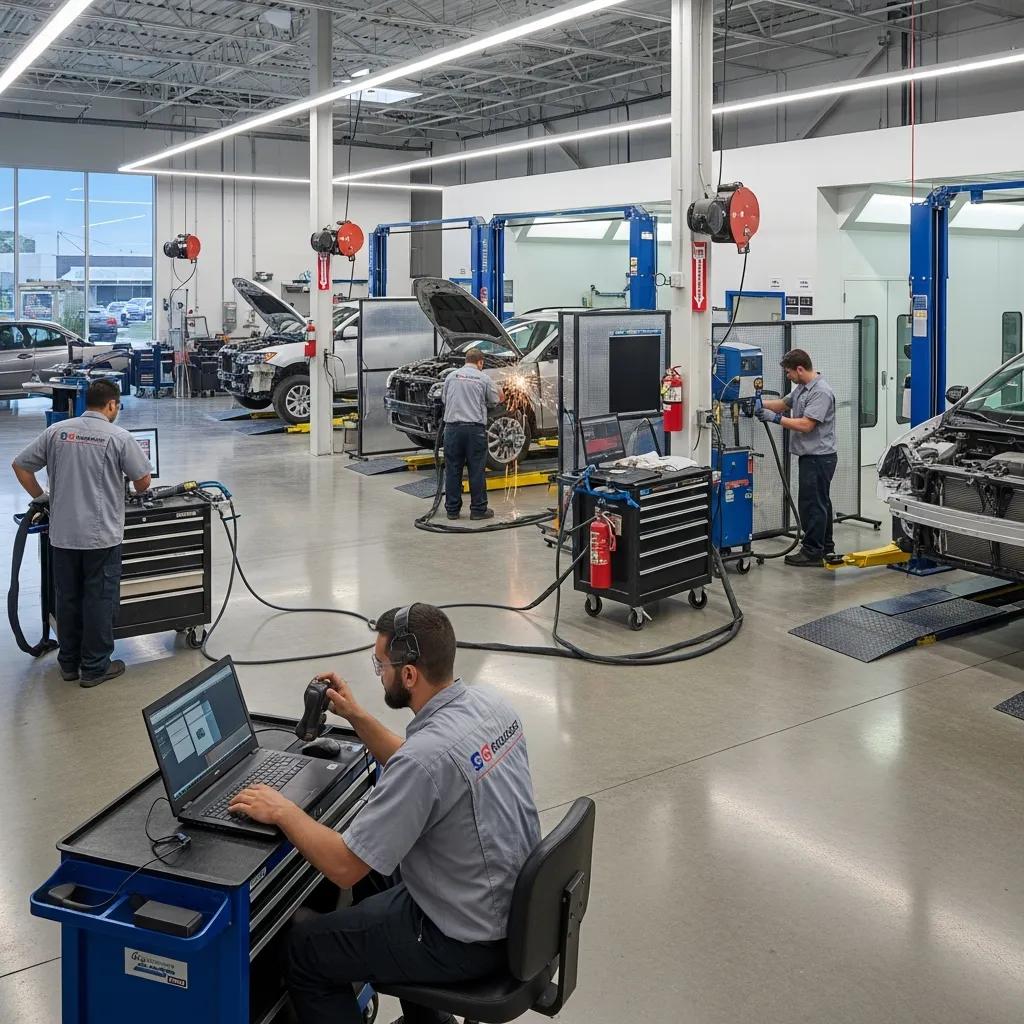
Modern collision repair depends on specialized equipment—frame machines, laser measuring systems, downdraft paint booths, and ADAS calibration tools—to reliably restore vehicles to manufacturer tolerances. Equipment such as computerized frame straightening rigs and laser measuring systems allow technicians to restore structural dimensions precisely, while professional paint booths and color-matching systems ensure durable, accurate finishes. ADAS calibration tools are essential for recalibrating cameras, radar, and lidar-based systems so that adaptive cruise control, lane-keep assist, and automatic emergency braking operate correctly after repairs. Verifying that a shop has the right equipment and trained technicians reduces the chance of hidden damage and supports a safer, longer-lasting repair outcome.
| Equipment | Purpose | Why It Matters to Consumers |
|---|---|---|
| Frame machine / laser measuring | Restores vehicle dimensions to manufacturer specs | Ensures correct structural alignment and crash performance |
| Downdraft paint booth & color matching | Controlled environment for paint curing and exact finish | Prevents paint defects and ensures color consistency |
| ADAS calibration tools | Recalibrates cameras, radar, and sensors | Restores active safety system accuracy for crash avoidance |
This equipment table highlights the tangible consumer benefits of modern tools and sets the stage for understanding ADAS calibration specifics and verification steps you can ask a shop to demonstrate.
What Is ADAS Calibration and Why Is It Crucial After a Collision?
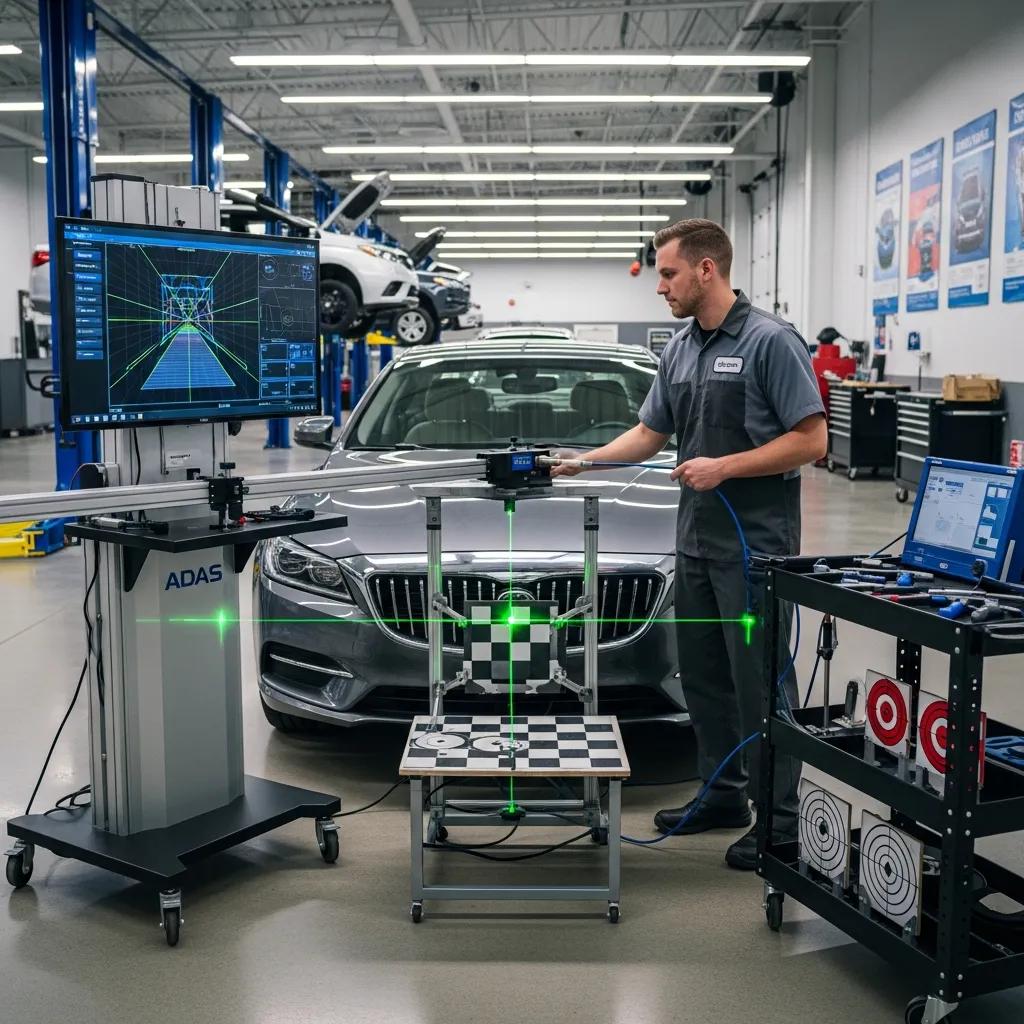
ADAS calibration is the process of realigning and recalibrating vehicle sensors—cameras, radar, and lidar—so the vehicle’s safety systems operate within manufacturer tolerances after body repairs or windshield replacement. Systems such as lane-keep assist, automatic emergency braking, and adaptive cruise control depend on precise sensor position and software configurations; miscalibration can lead to system errors or degraded performance that compromises safety. Verification steps include asking the shop for written calibration records, OEM procedure references, and demonstration that calibration equipment supports your vehicle make and model; some calibrations require dynamic road testing while others are static bench calibrations. Ensuring ADAS calibration is performed and documented is as critical as structural repairs, because sensor misalignment can negate the benefits of otherwise precise bodywork.
How Can You Verify a Shop’s Equipment and Technician Expertise?
Ask to see documentation of equipment ownership and technician training records, request a demonstration or photo of the calibration setup, and ask whether the shop follows OEM calibration procedures for your specific vehicle; these steps verify capability beyond marketing claims. Request technician names and certifications (I-CAR/ASE/manufacturer) and ask whether the shop’s equipment is updated to support the latest model-year diagnostic protocols; a competent shop will welcome these questions and provide clear answers. You can also request written repair plans that list the calibration steps and diagnostic checks to be performed post-repair, which creates accountability and a paper trail for warranty or insurance disputes. Verifying expertise and equipment protects you from shops that promise repairs but lack the tools or training to perform them correctly.
What Are Your Consumer Rights and How to Make the Final Decision?
As a consumer, you have the right to choose your repair facility, to receive a clear written estimate, and to request OEM parts or certified technicians where your policy permits; understanding these rights strengthens your negotiating position. Before authorizing repairs, confirm the scope of work, parts type, labor rates, ADAS calibration steps, and warranty terms in writing; insist that the shop document any supplements discovered during teardown. Use a scoring checklist to compare shops objectively across certifications, equipment, warranty, estimate transparency, and reviews, then weigh safety-critical items (certs, ADAS capability, OEM parts) more heavily than cosmetic factors.
The following prioritized questions and a sample scoring checklist will help you make a defensible final choice when multiple certified collision experts appear comparable.
What Questions Should You Ask Before Choosing a Collision Repair Shop?
Ask a shop whether they hold I-CAR, ASE, or manufacturer certifications and whether technicians have completed ADAS training specific to your vehicle; certification details indicate formal training scope and relevance. Request a written estimate that itemizes labor hours, parts types, paint processes, and ADAS calibration charges, and ask how supplements discovered during teardown will be handled and approved. Inquire about warranty language for parts and labor, who handles warranty claims, and whether the warranty is transferable on vehicle sale; understanding post-repair support reduces future friction. Finally, ask for references or before-and-after documentation for vehicles similar to yours and request proof of the shop’s calibration and frame measurement equipment; these questions prioritize safety and verifiability over price alone.
- Do you have I-CAR, ASE, or OEM certifications for this vehicle?
- Will you use OEM parts for structural/ADAS components?
- Is ADAS calibration included in the estimate and how is it documented?
- What warranty covers parts and labor, and how is a claim initiated?
- Can you provide references and photos of similar repairs?
These questions create a consistent interview script that you can use when comparing multiple shops and preparing your final authorization.
How to Use a Checklist to Select the Best Certified Collision Experts?
A weighted checklist lets you score each shop on objective criteria—certifications (20%), ADAS capability (20%), OEM parts policy (15%), warranty terms (15%), estimate transparency (15%), and reputation/references (15%)—and compute a composite score that balances safety and cost. For example, score each criterion 0–5, multiply by the weight, and sum to compare shops numerically; prioritize the highest-scoring shop unless budget constraints force a tradeoff. In value vs. budget scenarios, consider paying a premium for OEM parts and ADAS calibration when safety systems are affected, while accepting aftermarket trim pieces for non-structural cosmetic items to save cost. Using a checklist formalizes the decision process, reduces bias, and produces a defensible rationale to share with insurers or future buyers.
- Sample scoring guidance:
0–10 points: Poor match; likely avoid.11–20 points: Acceptable for minor cosmetic repairs.21–30 points: Recommended for structural or ADAS-related repairs.
This objective approach helps you balance competing priorities and choose a certified collision expert who aligns with safety, warranty, and value requirements.