
If your car took a beating from a Houston hailstorm, the fastest path is a free damage estimate so you know whether you need paintless dent repair (PDR) or conventional body and paint work. Most hail dents that haven’t cracked the paint can be fixed with PDR, which keeps your factory finish and is often quicker. Auto1StopShop estimates hail and storm damage at both Houston locations. Call (832) 400-5423.
Houston weather doesn’t ask permission. One afternoon it’s 95 and humid, and by evening a supercell is dropping golf-ball hail on the Gulf Freeway. Between spring hail season, summer flash floods, and hurricane season running June through November, your vehicle is exposed to more storm risk here than in almost any other major U.S. city. This guide walks you through spotting damage, understanding your repair options, filing storm-related insurance claims, and prepping before the next system rolls in off the Gulf.

How Houston Storms Damage Your Vehicle
Storm damage in Houston comes in three main forms, and each one calls for a different repair conversation:
- Hail damage: Ice stones punch shallow dents into your hood, roof, trunk lid, and door panels. Severity depends on stone size, wind angle, and how long you were caught in it.
- Wind and debris damage: High winds send branches, fence pieces, and loose objects into body panels, causing dents, deep scratches, and creased metal.
- Flood damage: Houston’s flash flooding can submerge a vehicle’s interior, electrical system, and drivetrain. This is the most serious category and often the hardest financially.
Knowing which type you’re dealing with helps you have a smarter conversation with both your shop and your insurer. Body and paint damage is highly repairable. Flood damage that reaches the engine or transmission is a different story, and we’ll be straight with you about that below.
How to Spot Hail Damage (Even When It’s Subtle)
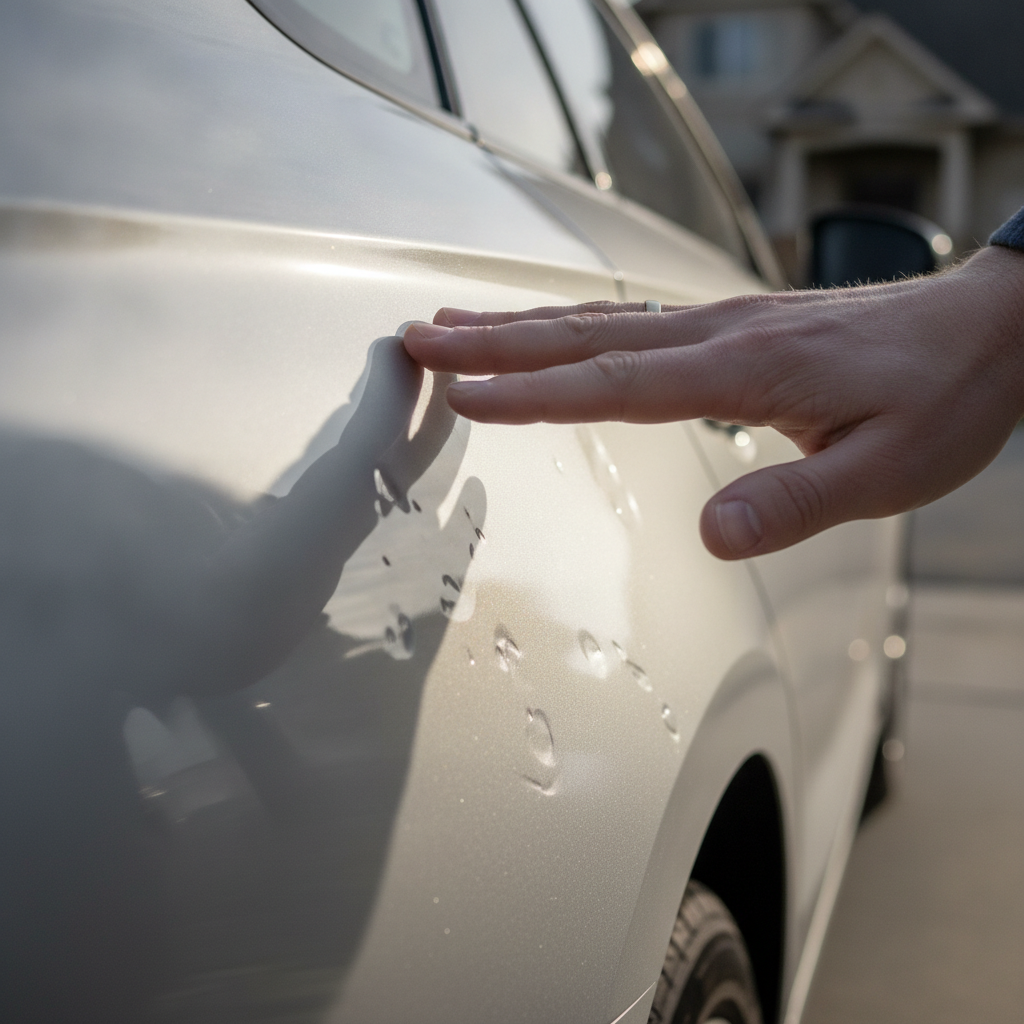
Hail damage isn’t always obvious, especially on lighter-colored cars or when the dents are shallow. Many Houston drivers don’t realize the extent of the damage until weeks later when sunlight hits the paint at the right angle. Here’s how to inspect properly:
- Check in raking light. Park in direct sun or shine a flashlight across the panel at a low angle. Dents cast tiny shadows that pop out when light skims the surface.
- Run your hand across horizontal panels. The hood, roof, and trunk take the worst of it because they face straight up. Feel for shallow dimples you might not see.
- Inspect the high points. Look at the tops of fenders, mirror housings, and the upper edges of doors where hail tends to land.
- Look for paint cracking or chips. If a dent has broken the paint, that changes the repair method. Cracked paint usually rules out paintless repair on that spot.
- Don’t forget glass and trim. Note any cracked windshield or broken trim. We don’t handle glass or windshield work, but you’ll want it documented for your claim and handled by a glass specialist.
Take dated photos of everything before you wash the car. Good documentation makes your insurance claim smoother and gives your repair shop a clear starting point.
Hail Repair Options: PDR vs. Conventional Body Repair
There are two main ways to fix hail dents, and the right choice depends on whether the paint is intact, how deep the dents are, and where they sit on the vehicle. Paintless dent repair is the preferred method for most hail damage because it preserves your original factory finish. When dents are too deep or the paint is cracked, conventional collision and auto body repair with refinishing is the better route.
| Repair Approach | Best For | What’s Involved | Key Advantage | Typical Cost Range* |
|---|---|---|---|---|
| Paintless Dent Repair (PDR) | Shallow to moderate hail dents with intact paint | Technicians massage dents out from behind the panel using specialized tools — no filler, no repainting | Keeps factory paint; often faster turnaround; no color-match concerns | Lower end; varies by dent count and panel |
| Conventional Body Repair + Paint | Deep dents, creased metal, or cracked/chipped paint | Panel is filled or reworked, primed, and refinished to match — see our car painting work | Restores severely damaged panels PDR can’t reach | Higher end; varies by panels and paint area |
| Combination Approach | Vehicles with mixed damage (some clean dents, some cracked) | PDR on intact panels, conventional repair where paint is broken | Saves cost where possible while fully restoring the car | Varies widely by damage spread |
*Cost ranges vary significantly by the number of dents, panel locations, vehicle make, and paint type. The only way to get an accurate figure is a free in-person estimate. We never quote a flat price sight-unseen.
For a single dent from a stray stone or flying debris, our focused dent repair service may be all you need. Widespread hail across multiple panels usually calls for a full assessment.
Storm Damage and Insurance: Understanding “Act of God” Claims
Hail, wind, and flood damage are typically filed under the comprehensive portion of your auto policy, not collision. In insurance language, these are sometimes called “Act of God” claims because no other driver is at fault — the weather caused the damage. A few things Houston drivers should know:
- Comprehensive coverage is what pays. If you only carry liability, storm damage generally isn’t covered. Check your policy before you assume.
- Comprehensive claims usually don’t raise your rates the way an at-fault collision can, though policies differ — confirm with your insurer.
- You choose your repair shop. In Texas, your insurer can recommend a shop, but the decision is yours. You’re free to bring your vehicle to Auto1StopShop.
- Document everything early. Dated photos, the storm date, and a written estimate strengthen your claim.
The claims process can feel like a maze of adjusters, deductibles, and supplements. Our team helps coordinate with your insurance company so the repair side runs smoothly — see how our insurance claim assistance works. We’ll walk you through the estimate, communicate with adjusters about the actual repair scope, and keep you in the loop.
What a Deductible Means for Hail Repair
Your deductible is the amount you pay out of pocket before insurance covers the rest. With widespread hail damage, the repair total often exceeds the deductible by a wide margin, so filing a claim makes sense. For a single minor dent, it may be cheaper to pay out of pocket than to file. A free estimate tells you which way to lean before you ever contact your insurer.
Flood Damage and Total-Loss Realities: The Honest Version
This is the part too many shops gloss over, so we’ll be direct. Flood damage in Houston is common and it’s serious. When floodwater rises into a vehicle, it doesn’t just soak the carpet — it can reach the electrical harness, control modules, the engine, and the transmission. Here’s what you need to understand:
- We focus on body, paint, and collision work, not mechanical or drivetrain repair. We do not service engines, transmissions, or do mechanical flood remediation. We won’t pretend otherwise to win a job.
- Flooded vehicles are frequently declared total losses. When water reaches the engine or electrical system, the repair cost often exceeds the car’s value, and insurers total it out. That’s a hard outcome, but knowing it early saves you money and stress.
- Never start a vehicle that’s been deeply flooded. Cranking a water-logged engine can cause far more damage. Have it assessed first.
- Mold, corrosion, and electrical gremlins show up later. Even “dried out” flood cars can develop problems months down the road, which is why insurers are cautious.
If your vehicle survived the storm with body and paint damage but the drivetrain is sound, that’s squarely in our wheelhouse. If the flooding was severe and mechanical, we’ll tell you honestly that you’re better served by your insurer’s total-loss process or a mechanical specialist. Straight answers save you time — that’s the whole point.
Houston Storm-Prep Checklist: Protect Your Vehicle Before It Hits
You can’t stop a Gulf storm, but you can cut your risk dramatically with a little preparation. Houston’s storm season overlaps spring hail, summer flash floods, and the June-through-November hurricane window, so it pays to stay ready year-round.
| When | Action | Why It Matters in Houston |
|---|---|---|
| Before storm season | Confirm you carry comprehensive coverage | It’s the only coverage that pays for hail, wind, and flood damage |
| Before storm season | Identify covered parking near home and work | A garage or carport is the single best defense against hail |
| Keep on hand | A thick hail blanket, moving blankets, or padded car cover | A quick cover can soften hail impact when no garage is available |
| When a warning hits | Move the car to high ground, away from flood-prone underpasses | Houston’s bayous and low spots flood fast — never park in a known flood zone |
| When a warning hits | Avoid driving through standing water | “Turn around, don’t drown” — just a foot of water can stall or float a car |
| After the storm | Photograph all damage with dates before washing | Clean documentation speeds up your comprehensive claim |
| After the storm | Get a free estimate before authorizing any repair | You’ll know your real options and whether to file a claim |
A practical Houston tip: when the forecast turns ugly and you have no covered parking, even moving your car to the side of a building that blocks the prevailing wind can reduce hail impact angles. It’s not perfect, but every bit helps.
What to Do Right After a Storm Damages Your Car
Move fast but in the right order. Here’s the sequence we recommend to Houston drivers:
- Make sure it’s safe. If the car was flooded, don’t start it. If there’s broken glass, be careful around it.
- Document everything. Take dated, well-lit photos of every dent, scratch, and panel before you clean anything.
- Get a free estimate. Bring the vehicle to Auto1StopShop so we can assess whether PDR, conventional body work, or a combination is the right call.
- Decide on a claim. Compare the estimate against your deductible and decide whether to file comprehensive.
- Let us coordinate the repair. If you file, we’ll work with your adjuster on the actual repair scope so nothing gets missed.
For minor cosmetic issues like a few light surface scratches from blown debris, a focused scratch repair or bumper repair may be all that’s needed — no need to overcomplicate it.
Why Houston Drivers Trust Auto1StopShop for Storm Damage
We’re a local Houston body and collision shop with two convenient locations: Southeast Houston at 8070 Moline St (77087) and Midtown Houston at 1710 W Dallas St (77019). We focus on what we do well — collision and auto body repair, paintless dent repair, painting, and restoration — and we tell you honestly when a job belongs somewhere else.
Whether you’ve got a hood full of hail dings or a single creased fender from flying debris, the first step is the same: a free estimate so you know exactly where you stand. Explore all our services or learn more about reaching either location.
Frequently Asked Questions
Can paintless dent repair fix all hail damage?
PDR works for most hail dents where the paint is still intact and the metal isn’t severely creased. It’s the preferred method because it preserves your factory finish. When dents are very deep or the paint has cracked or chipped, conventional body repair with refinishing is needed instead. A free estimate tells you which method fits your specific damage, and many Houston hail jobs use a combination of both.
Is hail damage covered by insurance?
Hail damage is typically covered under the comprehensive portion of your auto policy, often called an “Act of God” claim because the weather caused it. You’ll pay your deductible, and insurance covers the rest. If you only carry liability, storm damage generally isn’t covered. Comprehensive claims usually affect rates differently than at-fault collisions, but confirm details with your insurer.
Should I file a claim or pay out of pocket for hail repair?
It depends on the repair total versus your deductible. Widespread hail across multiple panels usually costs well above the deductible, so filing makes sense. For a single small dent, paying out of pocket may be cheaper than filing. Get a free estimate first so you can compare the actual repair cost against your deductible before contacting your insurer.
Do you repair flood-damaged vehicles?
We handle body, paint, and collision repair, but we do not service engines, transmissions, or perform mechanical flood remediation. If floodwater reached your drivetrain or electrical system, the vehicle is often declared a total loss, and you’ll work through your insurer’s total-loss process or a mechanical specialist. If the flooding only affected body and paint while the drivetrain is sound, that’s work we can do.
How soon should I get hail damage repaired?
Sooner is better. Some hail dents seem minor but can hide cracked paint that lets moisture in, leading to rust over time in Houston’s humid climate. Getting a prompt free estimate also keeps your insurance claim moving while the storm date is fresh. There’s no benefit to waiting, and several reasons not to.
Will hail repair affect my car’s value?
Quality paintless dent repair preserves your original factory finish, which is ideal for maintaining value because there’s no repaint or filler involved. When conventional repair and refinishing are required, proper color matching and workmanship keep the car looking right. The bigger risk to value is leaving damage unaddressed, where dents and exposed metal can lead to corrosion.
Hit by a Houston storm? Get a free hail and storm damage estimate at either of our Houston locations. Call Auto1StopShop now at (832) 400-5423 and we’ll help you figure out your best path forward.