An insurance estimate supplement in collision repair is an additional request for funding sent by your auto body shop to your insurance company. It covers hidden damage, updated parts prices, or necessary labor that was not included in the original insurance estimate. Because initial claims adjusters often write estimates based on surface-level photos, supplements are a standard, expected part of achieving a complete and safe repair.
If you have recently been involved in a car accident in Houston, you might be holding an initial estimate from your insurance company that seems surprisingly low. Many drivers look at this initial document and panic, wondering how a severely damaged vehicle can be fixed for such a small amount. The reality of modern auto body repair is that the first estimate is rarely the final bill. The collision repair process relies heavily on supplements to ensure every bent frame rail, shattered bracket, and misaligned panel is properly addressed.
Why the Initial Insurance Estimate is Rarely the Final Cost
In recent years, the auto insurance industry has shifted dramatically toward photo-based estimating. After a collision on busy Houston roads like I-45 or the 610 Loop, your insurance provider will likely ask you to upload photos of your vehicle to an app. A desk adjuster—who may be located in another state—will look at these photos and write an initial estimate based solely on what is visible to the naked eye.
The problem with this approach is that modern vehicles are incredibly complex. A plastic bumper cover is designed to flex and pop back into place, often hiding the catastrophic damage inflicted on the impact bar, crush zones, and mounting brackets underneath. When an adjuster writes an estimate from a photo, they are intentionally writing a “best-case scenario” document. They can only legally and ethically approve funding for damage they can definitively see and prove.
This is where the collision center steps in. Professional estimators know that a true assessment of collision damage is impossible until the vehicle is in the shop. An insurance estimate supplement collision claim bridges the gap between what the desk adjuster guessed from a photograph and what the auto body technicians actually found.
The Anatomy of an Auto Body Repair Supplement
A supplement is essentially a secondary (or sometimes tertiary) bill submitted to the insurance company with extensive documentation. When a reputable shop requests a supplement, they do not simply ask for more money; they provide a detailed, itemized list of required repairs backed by photographic evidence, OEM repair procedures, and diagnostic scan reports.
A typical insurance supplement includes requests for:
- Hidden Structural Damage: Frame damage, bent radiator supports, and crumpled inner structures that were concealed behind exterior panels.
- Broken Clips and Fasteners: One-time-use brackets, clips, and molding retainers that must be destroyed to remove damaged panels during the repair process.
- Updated Parts Pricing: Adjustments for parts that have increased in price since the initial estimate was written, or shipping and freight charges for hard-to-find components.
- Required Labor Operations: Time needed to perform safety-critical calibrations, clear diagnostic trouble codes, or execute complex multi-stage paint blending to match your vehicle’s factory color.
- Alternative Parts Sourcing: Requests to use original equipment rather than aftermarket parts if the quoted aftermarket part does not fit safely.
The Teardown Phase: Where Most Supplements Originate
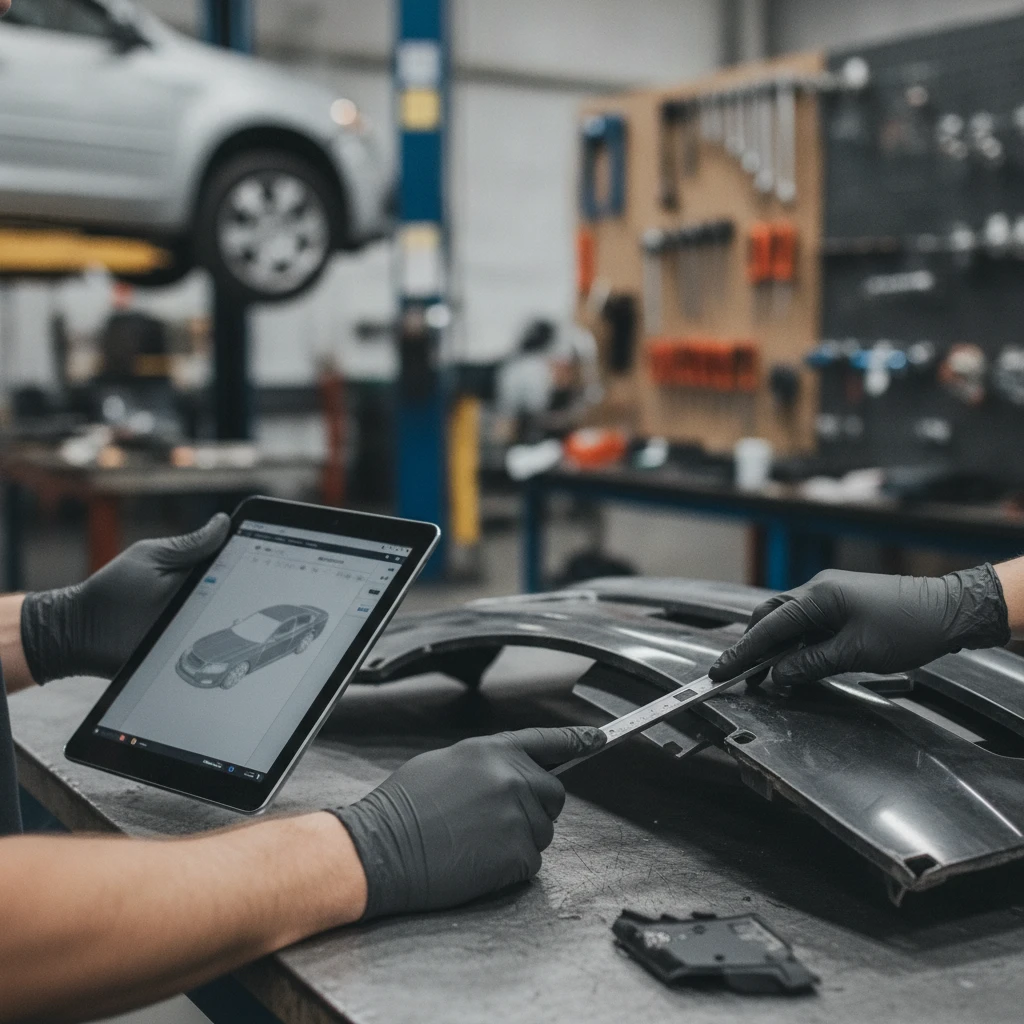
The supplement process almost always begins during a phase called the teardown or blueprinting phase. To truly understand what really happens inside a car body shop, you must understand blueprinting. Once your vehicle is dropped off, technicians systematically dismantle the damaged area.
If you brought your vehicle in for bumper repair following a rear-end collision, the technicians will remove the rear bumper cover, the taillights, and the trunk liner. Suddenly, what looked like a simple scratched bumper is revealed to be a crushed rear body panel and a compromised impact bar.
At this point, repair work on that specific area stops. The shop documents the newly discovered damage with high-resolution photos and detailed notes. This documentation is bundled into a supplement request and sent directly to the insurance adjuster. By thoroughly blueprinting the car before heavy repairs begin, the shop ensures all necessary parts are ordered at once, reducing delays later in the process.
Common Collision Scenarios Requiring Supplements
Different types of collisions result in different types of hidden damage. Houston drivers often face a variety of hazards, from severe thunderstorms to high-speed highway impacts. Below is a breakdown of how initial estimates typically compare to the actual damage found during a supplement request.
| Type of Collision | What the Initial Estimate Assumes | What the Supplement Usually Uncovers |
|---|---|---|
| Low-Speed Rear-End | Scratched bumper cover, minor paint work. | Crushed impact absorber, bent rear body panel, broken parking sensors. |
| Side-Swipe Impact | Dented door shell, scraped fender. | Damaged window regulators, bent side-intrusion beams, destroyed door hinges. |
| Front-End Collision | Broken grille, cracked headlights, dented hood. | Bent radiator core support, damaged cooling fans, misaligned frame rails, ADAS radar sensor failure. |
Please note: While collision supplements cover exterior bodywork, structural frame pulling, paint matching, and crash-sensor alignment, our collision services exclude general maintenance. We do not perform oil changes, tire replacements, brake jobs, or mechanical engine and transmission repairs unless explicitly noted as an excluded sub-contracted service related to the collision.
OEM vs. Aftermarket Parts in the Supplement Process
One of the most frequent reasons a shop files a supplement is to dispute the type of parts specified by the insurance company. Many insurance policies allow adjusters to quote aftermarket (third-party) parts or recycled (used) parts to keep costs down.
However, when the shop attempts to install these parts, they may find that the aftermarket hood doesn’t latch correctly, or the aftermarket fender has uneven panel gaps. Safety is paramount in collision repair. The National Highway Traffic Safety Administration (NHTSA) emphasizes the importance of structural integrity in crash safety. If an aftermarket part compromises the safety or structural integrity of the vehicle, the shop will halt repairs.
The shop will then file a supplement proving that the aftermarket part is inferior or unsafe, requesting approval to order OEM (Original Equipment Manufacturer) parts directly from the vehicle’s maker. Navigating the choice between OEM vs aftermarket parts is a critical step where your auto body shop acts as your advocate against cost-cutting measures.
How the Supplement Process Works (Step-by-Step)
Understanding the timeline of an insurance estimate supplement can help ease the frustration of waiting for your vehicle to be repaired. Here is how the process generally unfolds:
- Discovery: Technicians dismantle the vehicle and identify damage not listed on the original estimate.
- Documentation: The shop’s estimator takes photos, gathers OEM repair guidelines, and writes a detailed supplementary estimate.
- Submission: The shop submits the supplement directly to the insurance adjuster via an industry-standard estimating portal.
- Review and Approval: The insurance company reviews the claim. Sometimes, they approve it immediately based on the photos. Other times, they may deploy a field appraiser to the shop to verify the damage in person.
- Parts Ordering and Repair: Once the insurance company approves the additional funds, the shop orders the necessary parts and resumes the repair process.
During this time, communication between the shop and the insurance company is vital. According to the Texas Department of Insurance, consumers have specific rights regarding how claims are handled and settled. A professional body shop understands these regulations and works diligently to ensure the insurer honors their obligation to properly repair the vehicle.
Do You Have to Pay for an Insurance Supplement?
A common fear among drivers is that a supplement means they will have to pay more out of pocket. Fortunately, this is rarely the case when filing a covered claim. Your financial responsibility in a collision claim is typically limited to your deductible.
Whether the total repair costs $3,000 on the initial estimate or rises to $6,000 after three supplements, your deductible remains exactly the same. The insurance company is responsible for paying the difference covered by the supplement, up to the limits of your policy. If you are navigating a complex claim, relying on professional insurance claim assistance from your chosen body shop can ensure you aren’t unfairly burdened with hidden costs.
Understanding Texas car insurance claims for auto body repair ensures that you are not intimidated by the supplement process. Your insurance premium is based on the claim itself, not the number of supplements required to fix the car safely. The goal of the supplement is simply to ensure the insurance company pays what they truly owe to restore your vehicle to its pre-accident condition.
Frequently Asked Questions About Collision Supplements
How long does a supplement delay the repair process?
A supplement usually adds a few days to the repair timeline, though it can take longer depending on the insurance company’s responsiveness. The shop must wait for the adjuster to review the photos, approve the additional funds, and allow the shop to order the new parts. Delays are often out of the body shop’s hands and entirely dependent on the insurer’s approval queue.
Can an insurance company deny a supplement request?
Yes, an insurance company can dispute or deny a supplement. However, a reputable auto body shop will provide overwhelming evidence—including factory repair manuals and clear photographs—to prove the repair is necessary. If a denial occurs, the shop will work with you to explain your options and help you advocate for a safe repair.
Why didn’t the auto body shop catch all the damage during my initial walk-around?
Visual inspections are incredibly limited. Modern cars are built with tightly integrated layers of plastics, foams, sensors, and high-strength steel. It is physically impossible to see inner structural damage, cracked mounting tabs on hidden headlights, or wiring harness damage without putting the car on a lift and taking it apart.
Will an insurance supplement make my premium go up?
Filing a claim itself may impact your insurance premium depending on who was at fault, but the supplement itself does not act as a separate penalty. Whether a repair costs $2,000 initially or requires a $1,500 supplement later, it is still processed as a single continuous claim.
Get Help With Your Houston Collision Repair
Navigating the aftermath of a car accident is stressful enough without having to fight with insurance adjusters over repair costs. Supplements are a normal, vital part of the collision repair process, designed to protect you from driving a superficially repaired, unsafe vehicle. If you have received a surprisingly low initial estimate and need a team of experts to advocate for your vehicle’s structural integrity, we are here to help. For comprehensive collision repair and expert handling of your insurance estimate supplement, contact our Houston team today at (832) 400-5423.